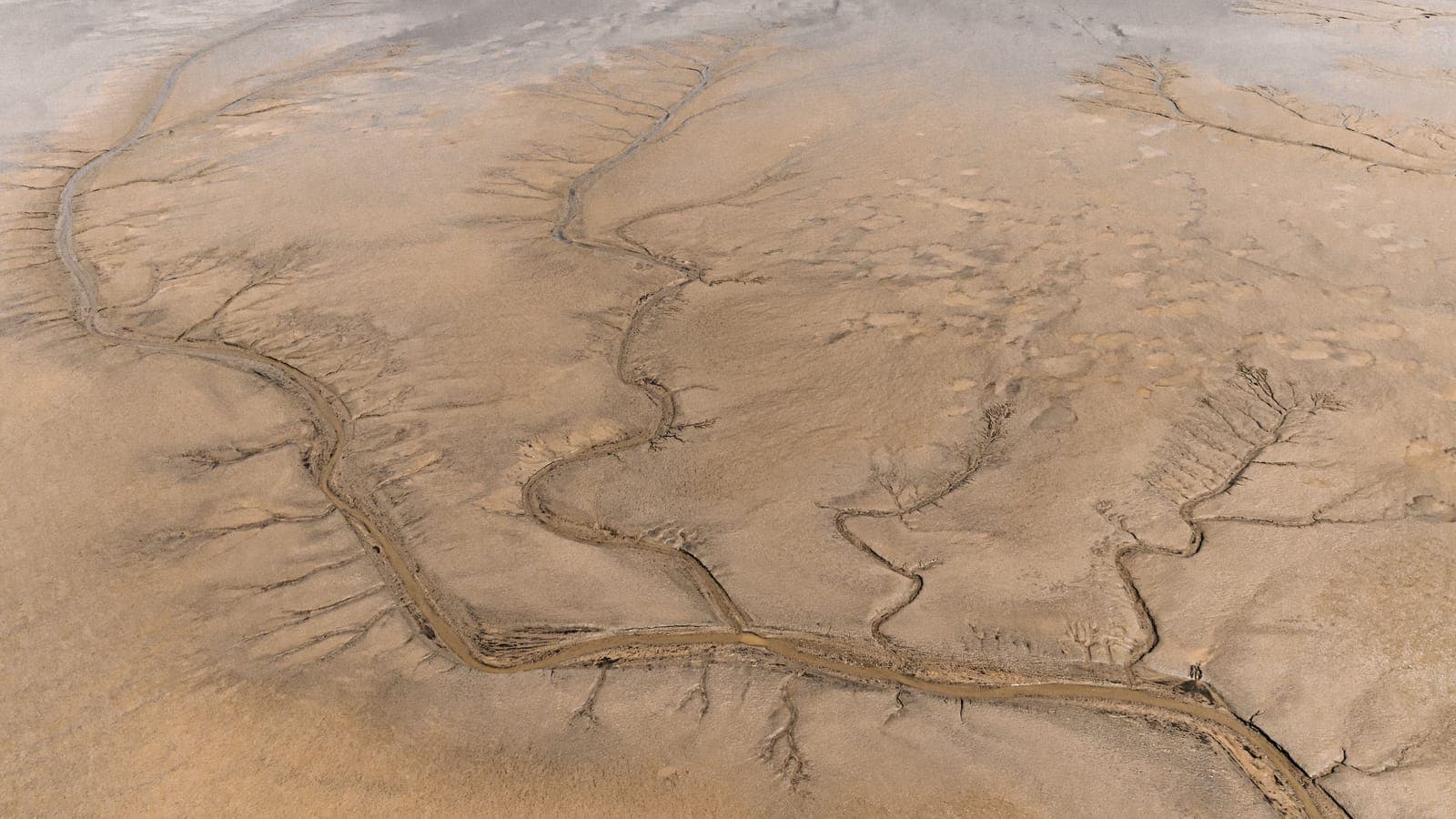
Childress is a small county seat at the eastern edge of the Texas Panhandle, the kind of ranching-and-railroad town where water has always been the limiting resource. In the last two years it has also become a magnet for some of the most power- and water-hungry industrial projects in the state: data centers. Two separate developments — one already operating, one still on the drawing board — are now taking shape around Childress at the same moment its main reservoir sits near record lows.
This article lays out what is actually confirmed about those projects, what remains unverified, and what the whole situation means for Childress County landowners. Our goal is the same as everywhere else on this site: clear, sourced information, without sensationalism, so you can understand what may be happening near your property and decide what to do about it.
Greenbelt Lake is near record lows
Childress and several neighboring towns draw their water from Greenbelt Lake, a reservoir on the Salt Fork of the Red River managed by the Greenbelt Municipal and Industrial Water Authority. As of late June 2026, the lake stood at roughly 6% of its conservation capacity — on the order of 3,600 acre-feet out of nearly 60,000 — according to the Texas Water Development Board's Water Data for Texas. Reservoir levels move constantly, so check the current figure before relying on it, but the trend is not in dispute: the lake has been critically low.
The strain is not new. The City of Childress moved into Stage 4 of its drought contingency plan in 2025 as the lake fell, easing only briefly when rain brought levels back up before they dropped again. For a community already rationing water, the arrival of large new industrial users is, understandably, a flashpoint.
IREN: from Bitcoin mining to AI
The first project is run by IREN (formerly Iris Energy), which operates a campus just outside Childress. It began as a purpose-built Bitcoin-mining site and is now adding artificial-intelligence computing. IREN's first AI building — a roughly 75-megawatt, liquid-cooled facility it calls "Horizon 1" — uses what the company describes as a closed-loop cooling system that needs water mainly for an initial fill rather than continuous draw, according to Data Center Dynamics.
Public descriptions of the campus's total acreage vary from one source to the next, so we don't cite a single number here. The crypto-to-AI pivot itself, though, is well documented — and it matters, because AI computing tends to draw far more power, and often more water, than the Bitcoin mining that came before it. For background on how these two uses differ, see our explainer on crypto mines versus data centers.
Lancium's "Childress Clean Campus"
The second project is much larger and still in development. Lancium, a power-and-land developer headquartered in Shenandoah, Texas (north of Houston), is planning a gigawatt-scale campus it calls the "Childress Clean Campus." Childress County established a Lancium reinvestment zone for the project on February 25, 2025; county records put the zone near 3,700 acres, and Lancium describes the campus as about 3,000 acres.
Lancium's marketing materials advertise a "one-gigawatt interconnect fully approved by ERCOT." We have not independently confirmed that approval through ERCOT's own records, so we treat it as the company's own claim rather than an established fact. On water, Lancium's CEO, Michael McNamara, addressed concerns at an April 9, 2026 Texas House State Affairs Committee hearing. As reported by Inside Climate News, he described the Childress facility drawing only about 11,000 gallons a day for its own use while returning roughly 1 million gallons a day to the Red River Water Authority by tapping and treating deeper aquifers — water he described as supply that local farmers and the authority had not been able to afford to develop on their own. Residents organizing against the project counter that any new wells ultimately serve the company's own enormous demand first. It is a treat-and-return arrangement built around a data center, not a civic gift — which is exactly why the specifics matter.
What the viral post gets right — and what it overstates
Much of the public alarm in Childress traces to a widely shared social-media post urging residents to fight the projects. A lot of it is grounded in real, verifiable facts: Greenbelt Lake really is near 6% full, the IREN and Lancium projects are real, and the county really did create a tax-favored reinvestment zone for Lancium.
Some of the post's headline numbers, however, are misread — or describe a different hearing:
- The "62% on a $20 billion investment for only 57 jobs" claim has real numbers but the wrong meaning. Childress County's executed Lancium tax-abatement agreement (Phase 1, March 10, 2025) does use "62%" and "$20 billion" — but the abatement is tiered, not flat: it abates 62% of the first $20 billion of the project's certified appraised value, plus 80% of any value above that. The county's own worked example puts the blended rate around 66%. The "$20 billion" is the threshold where the rate steps up — not a promised investment total; the agreement commits to no fixed dollar figure, only a first-phase minimum of 90,000 square feet and 90 megawatts built by the end of 2027. And the "57 jobs" figure appears nowhere in the county's records. This is a Chapter 312 value-based abatement — it ties the tax break to appraised property value, not to any job count. (The separate IREN / Iris Energy abatement in the same county is a flat 100% break on an estimated $197.5 million, 100-megawatt build, with annual payments to local schools and a per-megawatt fee in lieu of taxes.)
- The "June 23 testimony about digging wells for Childress" points to the wrong hearing. Lancium's CEO made his Childress water remarks at the April 9, 2026 House State Affairs hearing described above; the June 23, 2026 hearing was a different committee altogether — House Natural Resources — not the hearing where those remarks were made.
- The "1 gigawatt, ERCOT-approved" line is Lancium's own marketing claim, not a confirmed regulatory fact.
None of that makes the underlying worry wrong. Whether a giant, water- and power-hungry project that commits to no specific job count is worth a decade-plus of abated property taxes is a fair and important question — and one residents are right to ask out loud. What we've done here is point you to the actual documents so the debate runs on real terms rather than a viral soundbite. (The post may also be blending the Childress deal with a separate Lancium "Clean Campus" reported in neighboring Hall County, a different project with different terms.)
It's also worth being clear about framing. The loudest version of this debate calls for an outright ban on data centers. Our focus is narrower and, we think, more durable: making sure landowners whose water, land, or quiet enjoyment is harmed are protected and fairly compensated, and that the public can see the real terms of these deals.
What this means for Childress County landowners
If you own land or a well near one of these projects, a few things are worth understanding:
- Groundwater pressure. Even where a facility claims closed-loop or minimal surface-water use, large new wells can draw down the local water table. New high-capacity pumping near your property can affect nearby domestic, livestock, or irrigation wells — and in much of Texas, the Rule of Capture shapes who is liable when it does.
- Document your baseline now. If you have a well, recording its current depth, water level, and output gives you something to compare against later. Our guide on what to do if your well runs dry walks through the steps.
- Property value and nuisance. Noise, traffic, light, and air emissions from a large campus can affect nearby property values and day-to-day use of your land. See proving property-value loss and our overview of water-related harms.
- Public process. Abatement votes, reinvestment zones, and water-supply arrangements happen in public meetings. Attending them — and asking for the actual agreements in writing — is the most reliable way to learn the real terms.
This article is general information, not legal advice about your specific property or situation. For guidance on your circumstances, consult a qualified professional.
Frequently Asked Questions
Will the Childress data centers drain Greenbelt Lake?
Greenbelt Lake is already near record lows for reasons that predate the data centers, chiefly years of drought. Whether the facilities draw directly on the lake, on groundwater, or on other sources is one of the central open questions — and how each project is ultimately supplied has not been fully settled in public records. The concern is legitimate; the specifics should be confirmed from the water authority and the projects' own filings.
Does IREN really use "no water"?
IREN describes its newer Childress AI facility as using a closed-loop cooling system that needs water mainly for an initial fill rather than continuous use. That is the company's description. Even closed-loop facilities can still rely on water for other needs, and total campus water use depends on the mix of older and newer systems on site, so "no water" is better understood as "low ongoing cooling water, per the operator" than as zero.
Did Childress County give away too much in its tax deal?
Now that the signed agreement is public, the real picture is clearer than the viral version. The Childress County Lancium abatement is tiered — 62% of the first $20 billion of certified appraised value, then 80% above that (a blended rate the county itself estimates around 66%) — over a 10-year abatement window, and it commits Lancium to no fixed investment total and no specific number of permanent jobs (it is a value-based Chapter 312 deal). Whether that trade is a good one for the county is a fair debate; the point is that it should be argued from the actual agreement, which anyone can read on the county's tax-abatement page.
Is this about banning data centers?
No. Our position is not anti-technology or anti-data-center. It is that landowners harmed by these projects — through water loss, property-value decline, noise, or air impacts — deserve protection and fair compensation, and that the terms of public subsidies should be transparent.
What can I do if I think a data center is affecting my property?
Start by documenting conditions: well levels, noise, dust, and any changes over time. Attend the public meetings where these projects are discussed. And if you believe your water or property is being harmed, you can contact us for a free, no-obligation case review.
Check the records yourself
Don't take our word for it — or the viral post's. These are the primary, official sources for the facts above, so Childress residents can read them directly:
- Greenbelt Lake's current level — Water Data for Texas: Greenbelt Lake (Texas Water Development Board; updated daily).
- The actual tax-abatement agreements — the signed Lancium and IREN / Iris Energy agreements and the reinvestment-zone documents are posted on the Childress County tax-abatement page.
- The April 9, 2026 House State Affairs hearing, where Lancium testified on water — official hearing notice (PDF); the video is in the Texas House Committee Broadcast Archives at house.texas.gov.
- The June 23, 2026 House Natural Resources hearing on data-center water use — official agenda.
- Childress County government (commissioners court agendas and contacts) — childresstx.us.
Protecting your water and property
Childress sits at the intersection of two hard trends: a Panhandle water supply stretched thin by drought, and an industry that needs enormous amounts of power and, often, water. Those forces are not going away. The most practical thing a landowner can do is stay informed from sourced facts rather than viral numbers, document your own water and property conditions, and insist on seeing the real terms of the deals being made in your name. Knowing what's actually confirmed — and what isn't — is the first step to protecting your interests as these projects move forward.